
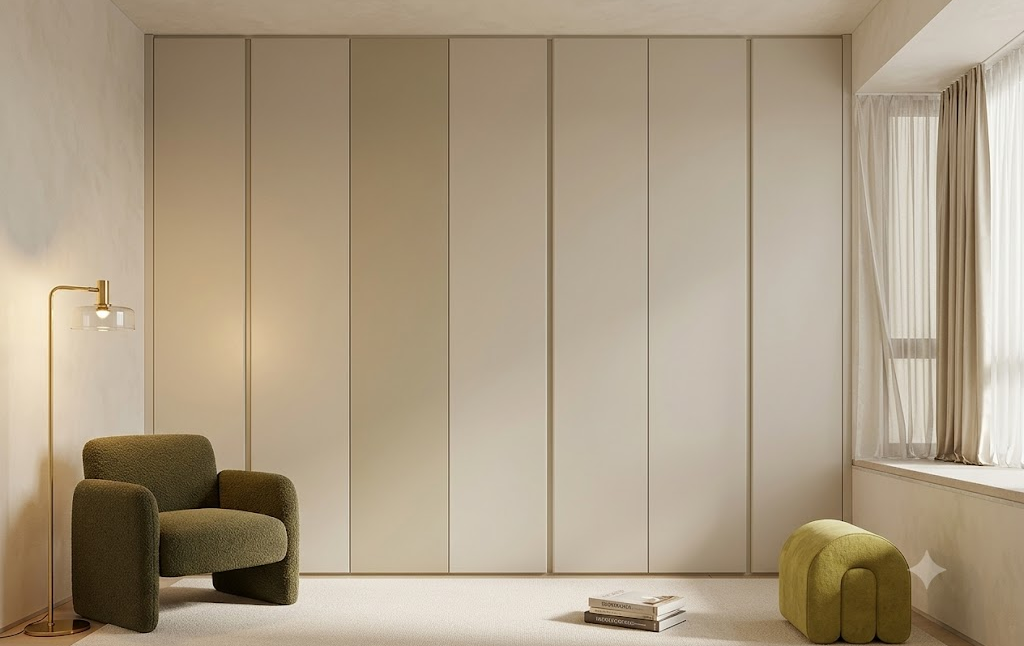
The biggest headache in renovation is picking the wrong wood panels. Warped cabinets, mold from moisture, strong unpleasant odors and excessive formaldehyde emissions all stem from poor panel choices. Many first-time homeowners cannot tell the differences between particle board, multi-layer plywood, ecological board, OSB and MDF, leaving them confused during selection. This guide fully explains how to pick household panels and their respective pros and cons, helping you avoid 90 percent of common renovation pitfalls.
First, particle board, the most widely used material for custom cabinetry. Manufactured by pressing wood scraps under high temperature, it boasts superior flatness, strong deformation resistance, great cost performance and an extensive range of surface finishes. It works well for wardrobes, TV cabinets, bookcases, entryway cabinets and other furniture in dry areas. Its only downside is weak waterproof performance, so it is not recommended for humid spaces such as kitchens and bathrooms. Premium particle boards from reputable brands feature high eco-grades and reliable stability, making them the mainstream choice for home use.
Next, multi-layer solid wood plywood, also known as veneer plywood. Constructed with thin wood sheets pressed in alternating cross directions, it delivers exceptional structural stability, high load-bearing capacity and better moisture resistance than particle board. It offers outstanding screw holding power and resists loosening and cracking. It is ideal for kitchen cabinets, balcony storage, bathroom vanities and tatami platforms that face humidity and heavy loads. It costs more than particle board, and is highly recommended for widespread home use if your budget allows.
Ecological board is a favorite among self-renovating homeowners. It requires no painting thanks to its paint-free surface that resists scratches and abrasion, with natural patterns and high environmental standards allowing immediate move-in. Built around a solid wood core, it presents a soft natural texture and suits wardrobes, shoe cabinets, storage units and children’s room furniture. Its drawback is inferior flatness compared to particle board; oversized minimalist cabinet doors may develop slight unevenness, so it is better suited for cabinet frames rather than doors.
OSB has gained huge popularity in recent years. Its oriented strand structure provides strong resistance to deformation, cracking and moisture. With no internal hollow spaces and uniform density, it generally achieves high environmental grades. It fits high-end custom designs of minimalist and light-luxury styles, usable for both cabinet doors and frames. Its only disadvantage is a relatively rough native grain, so veneer is required if you prefer a smooth delicate finish.
MDF features an ultra-fine even texture and excellent malleability, supporting all kinds of carved, curved and molded cabinet doors for European and French interior styles. However, it performs poorly against moisture and swells easily when exposed to water, so it should only be used for decorative doors in dry areas, never for cabinet frames.
Every panel serves unique purposes. There is no universally perfect panel, only the most suitable one for each space in your home. A well-matched combination cuts costs, extends service life and ensures eco-friendliness, letting you make independent panel choices without being misled by salespeople.
